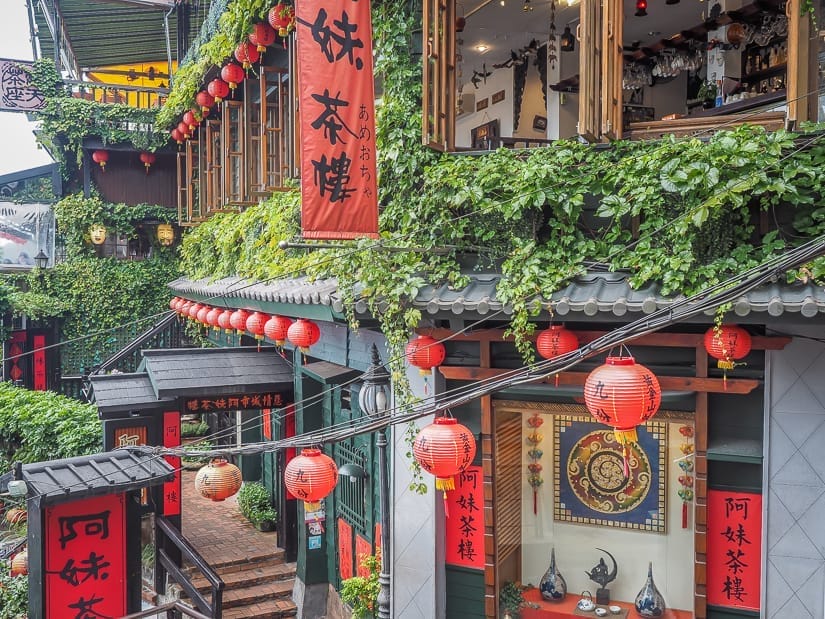
Jiufen (九份) is a mountaintop former gold mining town in New Taipei City on the northeast coast, and it is the single most popular day trip from Taipei. Visitors flock here because Jiufen Old Street packs the best of Taiwan into one small package: rich history, atmospheric lanes and teahouses, breathtaking views of the Pacific and Keelung Mountain, and distinctly Taiwanese snacks at every turn. The town's popularity has only been amplified by persistent claims that it inspired Studio Ghibli's Spirited Away, making it one of the most densely crowded tourist magnets in Taiwan.
Those Spirited Away claims are false. In a recorded interview, director Hayao Miyazaki directly stated that Jiufen was not the inspiration, pointing instead to Dogo Onsen in Matsuyama, Japan. But the myth has been repeated by so many bloggers, writers, and businesses that Jiufen and Spirited Away are now tied in the public imagination. Today you can buy Spirited Away souvenirs and paintings all over the old street, and nobody can deny that the narrow staircases with red lanterns and Amei Teahouse look straight out of the film.
A Quick History
In the Qing Dynasty, Jiufen was a tiny, isolated village with nine families who would request "jiu fen" or "nine portions" when supply ships arrived, giving the town its name. Gold was discovered in the 1890s, sparking a gold rush. Jiufen reached its peak during the Japanese colonial occupation (1895 to 1945), developing as a dense gold boomtown with buildings practically stacked on top of one another. During WWII the town was used as a POW camp. The gold industry declined after the war, and the mine closed entirely in 1971. Jiufen's revival came in 1989, when the Taiwanese film A City of Sadness, set in Jiufen, received international acclaim, sparking a tourism boom that has only grown since.
Jiufen Old Street and the Tea Houses
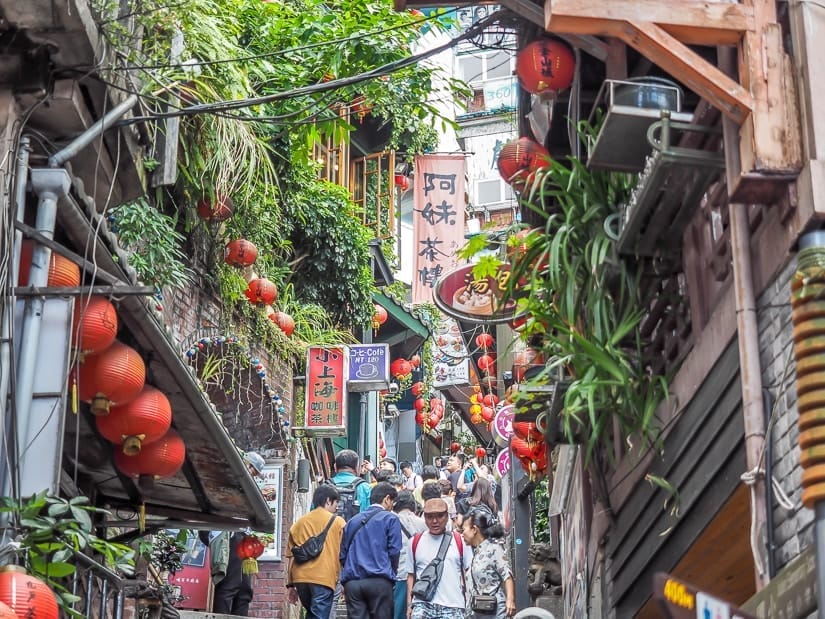
The main reason people come is to explore Jiufen Old Street, also called Jishan Street. The old street begins beside the 7-Eleven near the Jiufen Old Street bus stop and meanders uphill, with numerous lanes and staircases branching off. You could walk the whole tourist stretch in 30 minutes, but most people linger for a couple of hours of shopping, snacking, and tea.
The most iconic building in Jiufen is Amei Teahouse (阿妹茶樓), a beautiful wooden structure that once housed the town's only blacksmith. This is the building everyone photographs and the one that most resembles Spirited Away. It opens around 9:30 AM (earlier than the official 10 AM), and arriving at opening time is the best way to get the place to yourself. For the tea set, you choose hot or iced tea, and it comes with four little treats: brown sugar mochi, green bean cake, sesame crackers, and sweet plums. The tea is high mountain oolong, served in traditional kung-fu style, and the waiter gives a thorough English demonstration. For the classic photo of Amei Teahouse from above, climb the stairs to Skyline Tea House across the way.
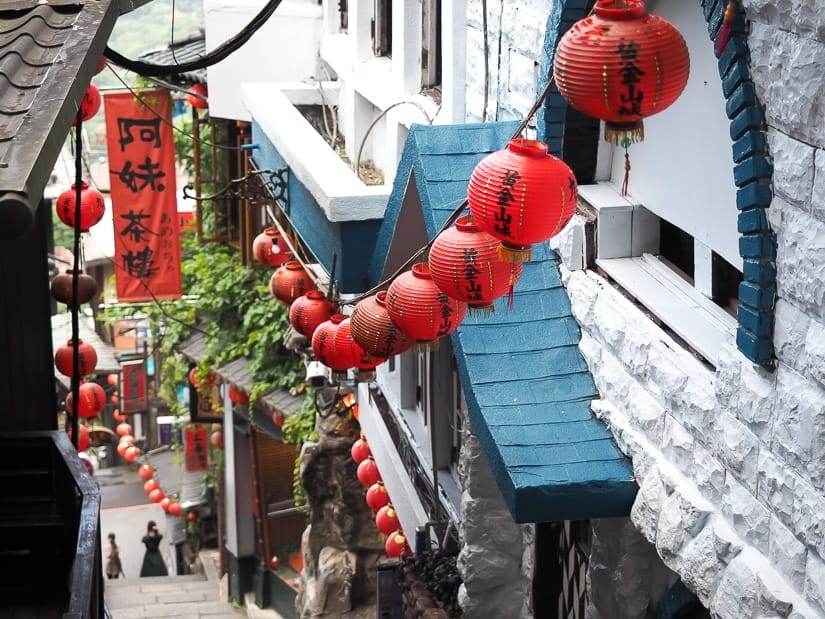
Other teahouses worth a stop include Jiufen Teahouse (九份茶坊) for serious tea drinkers who want a variety of fine local teas in a traditional interior, and Taiwan Sweet Potato Teahouse (芋仔蕃薯茶坊), which you enter through a stone tunnel miners once used to reach the Jiufen mine. Further up the old street, Forgetful House, Ocean See, and Shan Cheng Creation House offer quieter views with fewer crowds.
Taro Balls and the Food Alley
The most famous thing to eat in Jiufen is taro and sweet potato balls (芋圓 and 地瓜圓). You can find these chewy dessert shops throughout Taiwan, but the ones in Jiufen are especially good. The balls are fairly bland in flavor but it is all about the QQ chewy texture. They come hot or on ice in a slightly sweet syrup, often with beans.
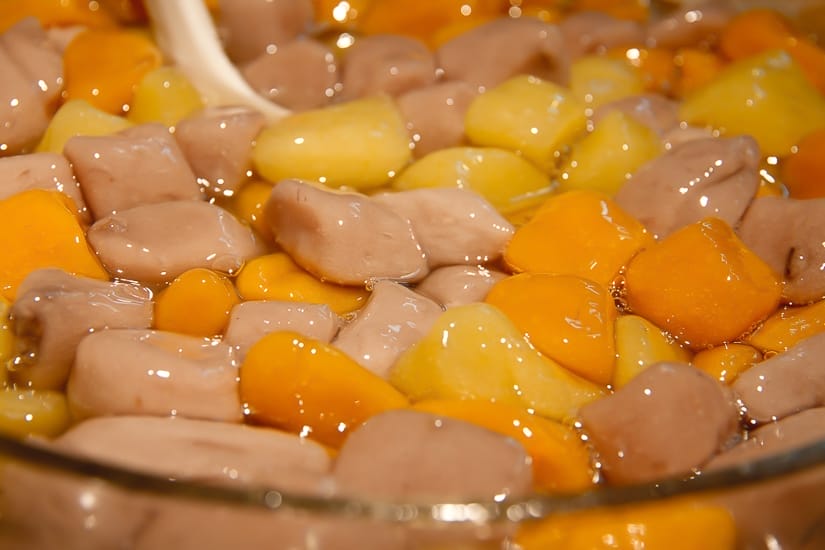
The two most famous stalls are Lai Ah Po Taro Balls (賴阿婆芋圓) right on the old street and Ah Gan Taro Balls (阿柑姨芋圓) up a staircase from it. At both, you can usually watch workers hand-making the balls. Other snacks to try include peanut ice cream rolls, you cong guo (deep-fried taro and meat dumplings), fish ball soup, and the taro-stuffed buns. Most restaurants are hole-in-the-wall shops with a few tables, though some have back rooms or second-floor balconies with views.
Views of Keelung Mountain and Getting There
Keelung Mountain (基隆山) is the 588-meter peak you see to the right when looking down from Jiufen. From the pavilion at the top you get an incredible view of Jiufen and as far as Taipei 101 on a clear day. The trailhead begins about 400 meters up the highway from the old street entrance, and the hike takes about an hour round trip, though it is steep and mostly stairs. For a longer adventure, the trail to Teapot Mountain starts inside the nearby Jinguashi Gold Ecological Park and leads to a rock pile shaped like a teapot that you can climb into.
The cheapest way to reach Jiufen from Taipei is bus 1062 from Zhongxiao Fuxing MRT station. The ride takes about an hour and costs around TWD 100. Buses run frequently but can fill up on weekends. Tourist shuttle bus 1062 is also free for Taipei Unlimited Fun Pass holders. Many visitors combine Jiufen with Shifen Waterfall, the Jinguashi Gold Ecological Museum (TWD 80 entry, where you can touch a 220-kg gold bar), the Golden Waterfall, or a stop at Keelung Night Market on the way back. Organized day tours from Taipei that bundle several of these sights are popular and often cheaper than going independently.
Practical Tips
Jiufen gets ridiculously crowded every day of the year. The best time to visit is from 10 AM (when most things open) until around noon. In the afternoon to early evening, crowds reach their peak, then taper off as the lanterns come on after sunset. Mondays are a great day to visit because the crowds are thinner, unlike most Taiwan attractions that close on Mondays. Jiufen stays open every day. There are lots of stairs, so visitors with bad knees or small children should ask a taxi or driver to drop them at the top of the old street and walk down. A recent rule change bars drivers from dropping passengers at the main entrance due to crowding, so expect a 10 to 15 minute walk from the parking lot.